The Short Answer
A crawl space dehumidifier is what keeps a sealed crawl space actually dry. In Northwest Arkansas, sealing alone is half the job: our long humid season pushes vented crawl spaces past the moisture level where mold grows, and even a well-sealed space needs mechanical drying to hold a safe humidity year-round. A dedicated unit — sized to the space, draining automatically — is the difference between crawl space encapsulation that works and encapsulation that grows things.
Why Vented Crawl Spaces Fail in an Arkansas Summer
The physics is unforgiving. Summer air in Benton County arrives warm and loaded with moisture. When it vents under your house, it meets framing and ductwork cooled by your air conditioning, and the moisture condenses — the same reason a cold glass sweats on a porch. Day after day, that condensation feeds mold on joists, rusts duct work, and soaks insulation until it falls. Opening more vents makes it worse, not better. The modern fix, reflected in current building practice for unvented crawl spaces, is to close the vents and dry the air mechanically.
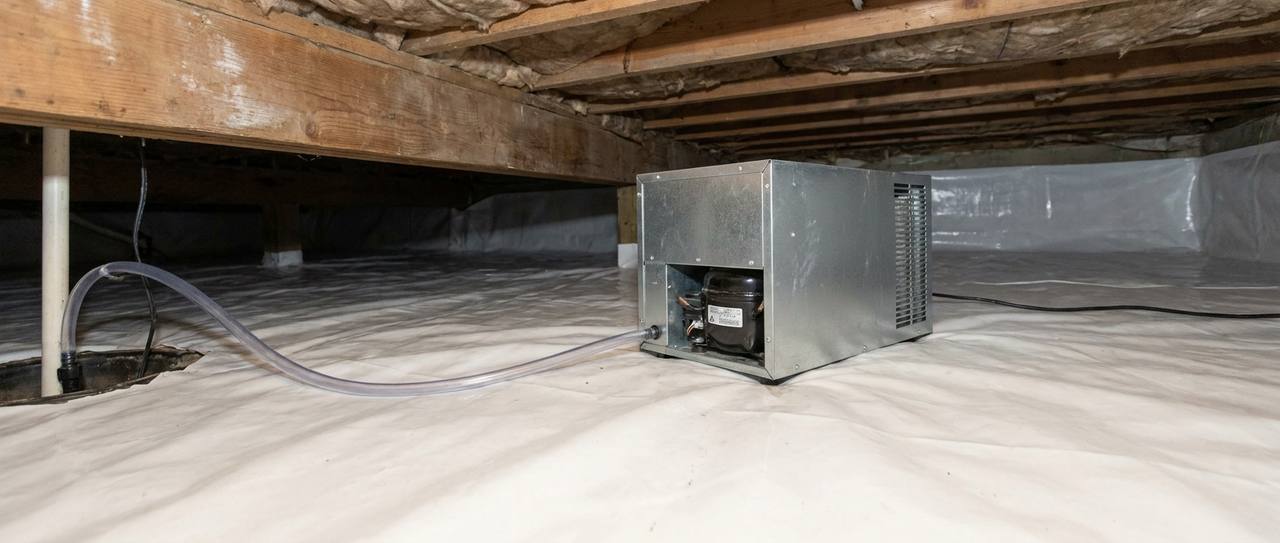
What the Right Crawl Space Dehumidifier Looks Like
- Sized in pints per day, not price. Typical crawl space units remove 70–100+ pints of water daily. Undersized units run constantly and still lose the summer.
- Automatic drainage. Condensate routes to a sump, condensate pump, or gravity drain. If someone has to crawl under the house to empty a tray, the tray will not get emptied.
- A humidistat that holds the line. Set it and forget it — the unit cycles to keep relative humidity below the mold threshold without running around the clock.
- Installed in a sealed space. A dehumidifier in a vented crawl space is trying to dry all of Benton County. Sealing first is what makes the machine's job finite — see the full encapsulation picture.
Cost-wise, a quality crawl space dehumidifier installed runs roughly $800–$2,500 depending on capacity and drainage routing. It is the wear item in an encapsulation — expect appliance-length service life — and the piece cheap quotes most often quietly omit.
Living With a Crawl Space Dehumidifier
Owners ask three practical questions, so here are the practical answers:
- What does it cost to run? A humidistat-controlled unit in a sealed crawl space cycles rather than runs continuously. Once the space is dried out after installation, duty cycles drop sharply — the humid Arkansas months work it hardest, winter barely at all. Expect a modest, seasonal line on the electric bill, not a second HVAC system.
- What maintenance does it need? A filter cleaning once or twice a year and a glance at the drain line — both reachable from the crawl space access without a full crawl on a properly planned install. Units positioned for serviceability are a mark of an installer who expects the system to be maintained rather than forgotten.
- How do I know it is working? The honest answer is a humidity reading, not a feeling. A wireless hygrometer placed in the crawl space reports to a display upstairs for the price of a dinner, and it turns "I think it is fine down there" into a number you can check from the kitchen. Any reading holding under the mold threshold means the system is doing its job.
One caution from the field: a household dehumidifier from a big-box store is not a crawl space unit. Residential units are not rated for low-clearance spaces or unconditioned winters, their reservoirs need hand-emptying, and their capacity collapses exactly when an Arkansas summer demands the most. If a quote includes a machine you could buy at a department store, that quote is telling you how the rest of the job was scoped too.