The Short Answer
A vapor barrier is a plastic liner over the crawl space ground; encapsulation is a sealed system. The barrier alone blocks ground moisture from evaporating into your crawl space. Full crawl space encapsulation takes the same idea to the finish line: heavier 20-mil material run up the walls, seams sealed, vents closed, and a dehumidifier drying the air. Which one your Bentonville home needs depends on how wet your crawl space actually is — and that is an inspection question, not a sales question.
Vapor Barrier Grades: 6-Mil vs 12-Mil vs 20-Mil
- 6-mil polyethylene. The builder-grade sheet many NWA homes already have — often torn, displaced, or covering half the floor. As a ground cover in a dry crawl space it is better than bare dirt; as a moisture solution it is a bandage.
- 12-mil reinforced. A legitimate mid-grade liner for crawl spaces that need real coverage without full encapsulation. Survives crawling and stays put.
- 20-mil reinforced. Encapsulation-grade: polyester-cord reinforced, sealed at every seam and pier, durable enough to use the space for storage. This is what "crawlspace encapsulation" means on our cost page.
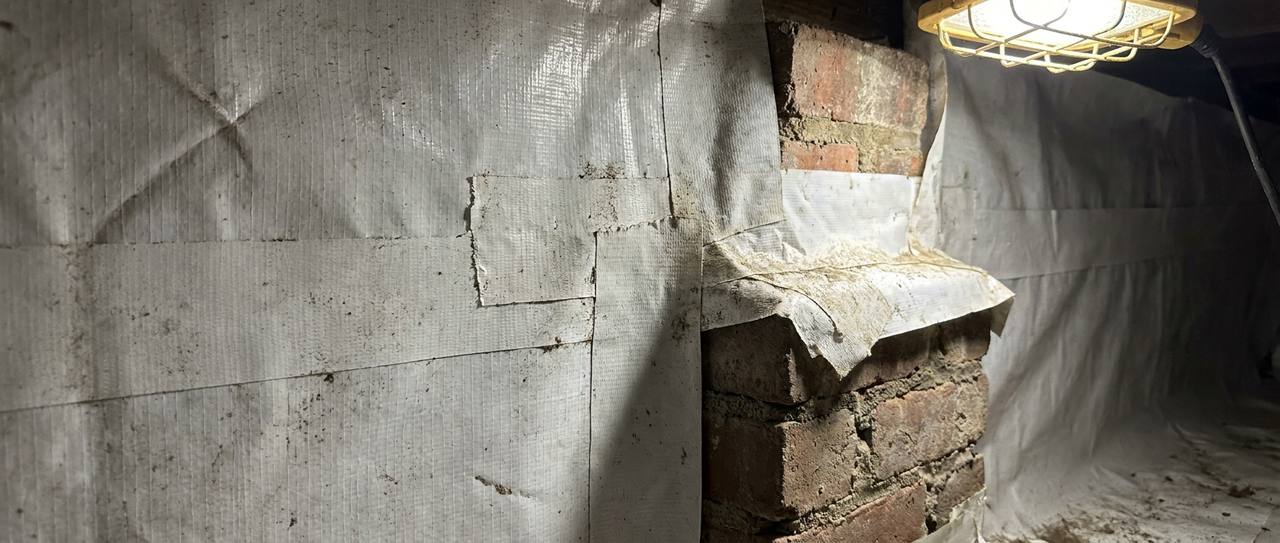
Vapor Barrier or Full Encapsulation — a Bentonville Decision Guide
A local Reddit homeowner put the question perfectly: a roughly 20-year-old Northwest Arkansas home on the side of a hill — barrier or full encapsulation? The honest framework:
- Dry crawl space, no musty smell, no visible moisture: a quality ground-cover vapor barrier is often enough. Keep the vents, skip the dehumidifier, save thousands.
- Humidity symptoms — musty smell, condensation, surface mold, damp insulation: a barrier alone will not fix air moisture. This is encapsulation territory: seal it and dry it.
- Liquid water after storms: neither fixes it alone. Drainage comes first, then the liner. Hillside homes on our karst ground hit this case most.
That hillside detail matters here more than most places. Sloped lots across Bentonville, Bella Vista, and Rogers drain unpredictably through fractured Boone Formation limestone, and a crawl space that stays dry through July can take water in a single spring storm. It is why we look before we quote.
What Professional Vapor Barrier Installation Involves
The material is the cheap part; the installation is the product. A vapor barrier install that will still be working in ten years looks like this:
- Clear the ground first. Old plastic, fallen insulation, construction debris, and any sharp rock come out. A liner laid over debris punctures, bridges, and never seals.
- Full coverage with overlapped seams. Sheets overlap generously and get taped with the manufacturer's seam tape — not duct tape, which lets go in crawl space humidity within a season.
- Piers wrapped, edges secured. Every support pier gets wrapped and sealed; the liner's edges are fastened so foot traffic and settling cannot pull the system apart.
- Wall runs where the job calls for them. A ground cover stops at the footing; an encapsulation-grade install carries the liner up the foundation walls and seals it near the sill, stopping wall seepage and earth contact entirely.
The most common failure we see under Bentonville and Rogers homes is not a missing vapor barrier — it is a fifteen-year-old sheet of builder plastic doing five percent of the job: torn where the plumber crawled through, shoved into a corner, moisture beading on its underside. If that describes what is under your house, the fix is not more plastic on top. It is pulling the old material, correcting whatever moved it, and installing a system with sealed seams that stays put. The inspection is free, the photos are yours either way, and if a simple ground cover genuinely covers your situation, that is exactly what we will tell you.